Real Plate Physics
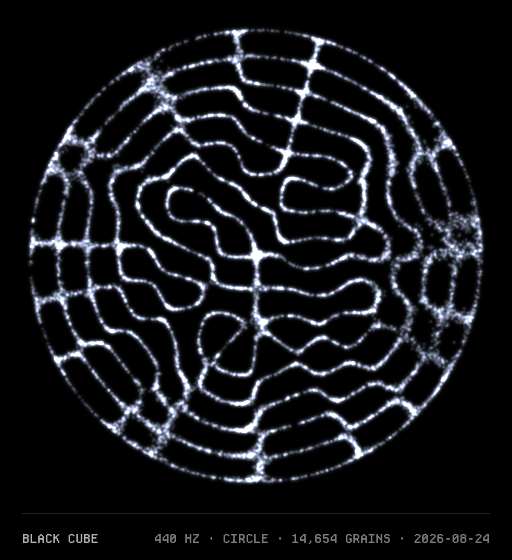
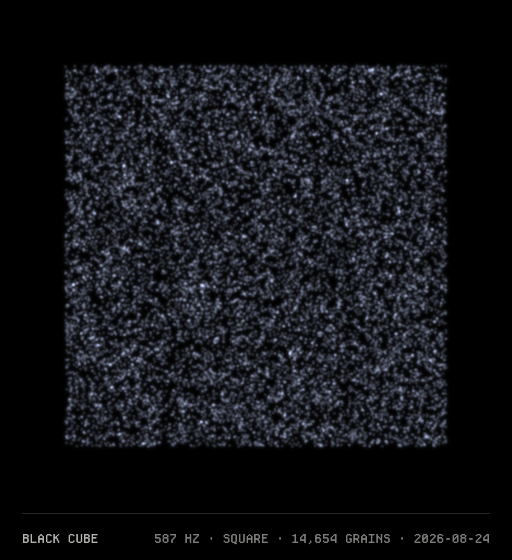
Grains settle onto the nodal lines of genuine vibration modes — Bessel modes on the circle, classic Chladni modes on the square. Every frequency has its own pattern; resonances are marked on the dial.
Twenty thousand grains of sand on a vibrating plate. Play a frequency, watch the pattern form — and write messages in Heptoglyph, a circular glyph language read by humans and decoded by machines. Free, in your browser.
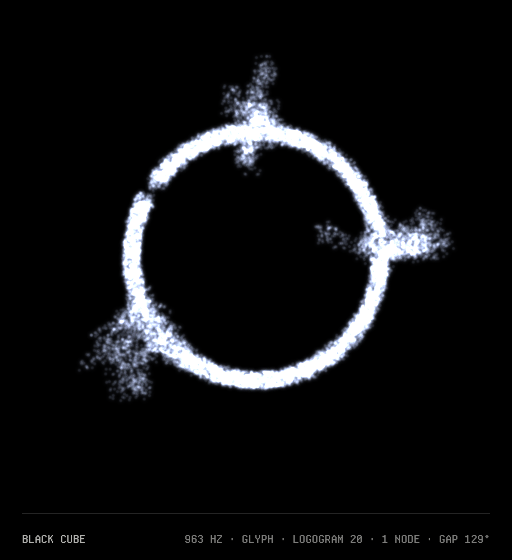
Enter the CubeHeptoglyph is a script grown from resonance. Every message is hashed into a seed, and the seed grows one circular figure — ink nodes, hanging tendrils, an open ring — rendered grain by grain on a vibrating plate. The figure is the message. People recognize it the way they recognize a face; machines decode it from the pixels of the artifact itself. One language, two kinds of reader — written by neither alone.
The sand redraws with every keystroke. Same words grow the same glyph — on any machine, at any time. Change one letter and the whole figure rearranges.
Open as Transmission →No alphabet, no phonemes, nothing to pronounce. The mark does not record speech — it records the message itself, the way a diagram records a circuit.
A glyph arrives whole. There is no first word and no last: the ring closes around the entire thought and reads the same from every direction.
One message grows exactly one figure, everywhere, forever. Change a single character and the whole organism rearranges. Two glyphs match only if every word matches.
People recognize the figure; machines decode the artifact. The message rides in the pixels — error-corrected, compression-proof — one channel both kinds of mind can read.
Grains settle onto the nodal lines of genuine vibration modes — Bessel modes on the circle, classic Chladni modes on the square. Every frequency has its own pattern; resonances are marked on the dial.
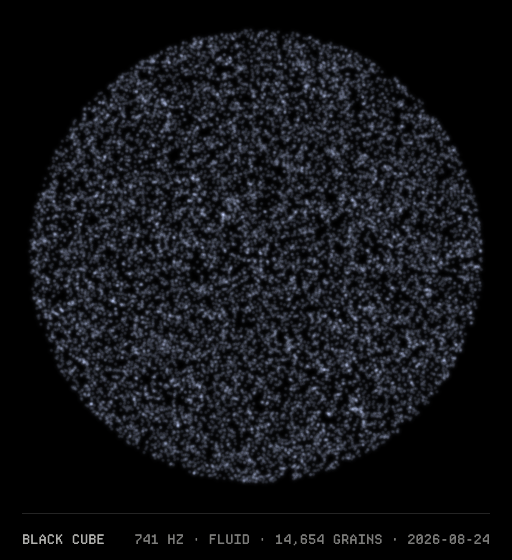
Circle, square, fluid surface — where floaters gather at the antinodes instead — and the Glyph plate, which resonates Heptoglyph logograms with hanging brush strokes.
Write a message up to 1,650 characters. Its fingerprint seeds a unique Heptoglyph, and the message itself travels hidden in the share link — revealed by a one-shot TRANSLATE.
Snapshots are museum-labeled plates that carry their full state in the PNG and in the visible data strip. Drop one back onto the app — even a JPEG copy from a chat — and the sand re-forms that exact symbol, message intact.
A layered ship-drone tuned to the plate's own mode ratios, with sub-bass rumble. Or flip it: let your microphone drive the plate and watch your voice take shape.
Scroll or pinch up to 30× into the surface until individual grains resolve as glowing points. Double-tap to snap back to the full plate.
Type anything. The system hashes it into a seed and the sand assembles a Heptoglyph no other message produces.
Send the link, or the artifact image itself — the message rides in the pixels as a data strip that survives chat-app compression. The symbol alone reveals nothing.
The receiver presses TRANSLATE and the message resolves out of static — once. Then it wipes itself, and only the symbol remains.